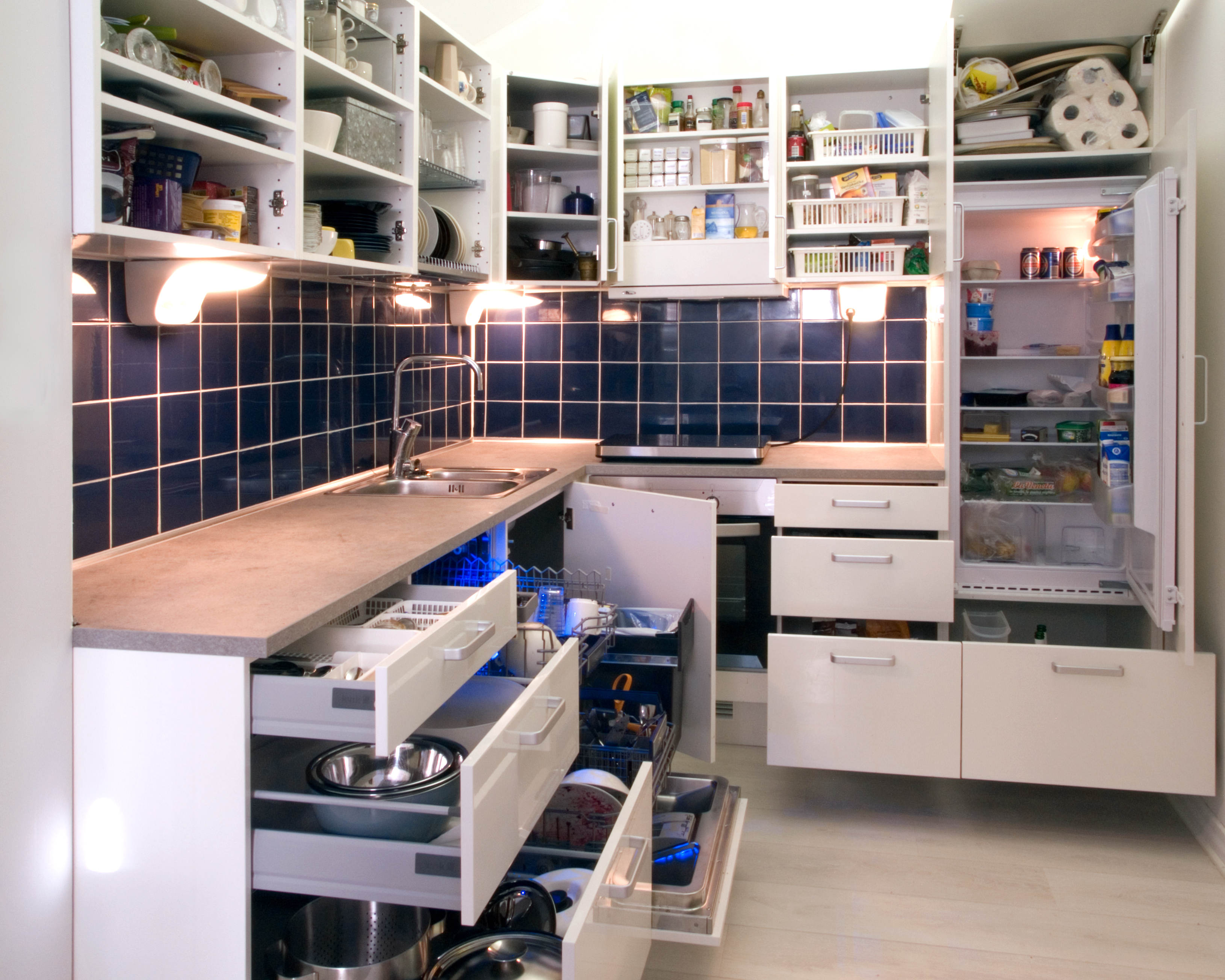
Why kitchen storage fails
Kitchen storage problems in Polish flats are largely structural. Standard fitted kitchens installed in most block-of-flats renovations from the 1990s to the 2010s follow a fairly uniform layout: upper cabinets over a work surface, a base cabinet run, and a fridge positioned at one end. The interior fittings of those cabinets — fixed shelves, a single cutlery tray — rarely match how the kitchen is actually used.
The most common failure points are: deep lower cabinets where items at the back become inaccessible, upper cabinets used for storage so irregular that nothing has a stable location, and a work surface that becomes a default landing zone for items that have nowhere obvious to go.
Working from the cooker outward
The most useful framework for kitchen storage is proximity to the point of use. Items used during cooking — oils, salt, frequently used spices, knives, chopping boards — should be within arm's reach of the cooker without opening a cabinet door. Items used for preparation — mixing bowls, scales, a colander — should be one step away. Items used infrequently — a roasting tin, a blender used monthly — can be stored in less accessible locations.
This principle often contradicts the visual uniformity that new kitchen fittings suggest. A spice rack mounted on the wall beside the cooker looks less tidy than spices stored inside a cabinet, but substantially reduces friction during cooking.
Lower cabinets
Pull-out drawer inserts (szuflady wewnętrzne) convert a deep lower cabinet from a space where items are stacked and hidden to one where everything is visible at a glance. For existing cabinets without pull-outs, wire basket inserts mounted on sliding rails achieve a similar effect. Both are widely available from Polish home-improvement stores including Leroy Merlin and Castorama.
Pots and pans, which tend to be the most awkward items in a lower cabinet, store more accessibly when lids are kept separately — either in a vertical lid rack or in a dedicated drawer — rather than stacked with the cookware.
Upper cabinets
Upper cabinets have two practical zones: the shelf at eye level when the door is open, which is accessible without effort, and the shelf above it, which requires reaching. The eye-level shelf should hold items used multiple times a week; the upper shelf should hold items used occasionally.
A turntable (lazy Susan) on a deep upper shelf makes corner and rear items accessible without removing everything in front. A single turntable in a corner upper cabinet is often more effective than reorganising the entire upper cabinet run.
The work surface as a storage problem
A clear work surface makes kitchen tasks faster and reduces the chance of cross-contamination between food preparation areas and non-food items. The work surface becomes cluttered primarily when items lack a specific storage location — they land on the surface because there is no more convenient alternative.
Identifying the five or six items that consistently end up on the work surface and finding a dedicated location for each (a hook, a drawer, a wall bracket) typically resolves most of the clutter. A kettle and toaster, for example, are frequently used and reasonably kept on the surface; a bag of crisps, a charger, and a collection of takeaway menus are items that landed there because no alternative existed.
On dry goods storage
Decanting dry goods (flour, pasta, rice, lentils) from their original packaging into uniform containers reduces the space they occupy and makes quantities visible. Glass jars or stackable plastic containers allow a shelf of dry goods to be scanned in seconds. Original packaging is irregular in size and collapses when partially empty, making it difficult to stack.
Under the sink
The cabinet under the sink is among the least efficiently used spaces in most kitchens. The plumbing takes up a significant portion, the remaining space is irregular, and the combination means items stored there are difficult to see and access.
A two-level adjustable shelf that fits around the plumbing doubles the usable area. Cleaning products, stored here, are typically accessed one at a time; a small turntable or pull-out shelf makes individual items accessible without removing everything else.
Pantry and food storage
Where a separate pantry cupboard (spiżarnia) exists, the same principles of proximity and visibility apply. Most-used items at eye level, less-used items higher or lower, and a consistent rotation system — new purchases placed behind older stock — prevents items from reaching their best-before date unnoticed.
Where a dedicated pantry doesn't exist, a tall cabinet or a section of shelving in an adjacent room can function as one. The critical factor is that food storage should be cool, away from direct light, and separate from cleaning products.
What doesn't fit in a standard kitchen
Some items — a pasta machine used once a year, a large preserving pan, a second slow cooker — occupy cabinet space disproportionate to their frequency of use. In a small Polish kitchen, these are better stored elsewhere: a storage space in the corridor, a cellar, or a high shelf in another room.
The kitchen works most efficiently when it contains the items actually used in it, rather than functioning as the default storage location for every kitchen-related object owned.
Related reading: How to Organise Your Wardrobe and Bathroom Organisation Tips.